
Seminole County Criminal History Checks
No single office holds a complete Seminole County criminal history. Begin with the Seminole County Clerk court-record search when the goal is to learn what charges were filed and how each count ended. Use the sheriff's current-inmate tool for present custody, then ask the agency that made the arrest for its report. A city police narrative does not move to the Sheriff's Public Records Unit merely because the person was booked in the county jail.
Prepare a full name, spelling variants, an approximate event date, and a case or booking number if known. A date of birth can help separate people with similar names, but public fields may be limited. Read each source for its own purpose and never treat a name match as proof of identity.
- Search the Clerk by name, case number, or citation and narrow the result to the right criminal case.
- Read each filed count, docket event, disposition, and sentence instead of stopping at the opening charge.
- Check current custody through the sheriff when the arrest may be recent.
- Request the event narrative from SCSO or the city police department that created it.
- Use FDLE for a statewide history, or request fingerprint Personal Review for your own record.
The official Clerk search interface shows where a Seminole County court lookup begins.

Its results should be read count by count because the filed accusation and final court outcome can differ.
Seminole Criminal Records at Five Points
Seminole County's main record offices sit close together on Sanford's Five Points campus, yet they serve different roles. The Criminal Justice Courthouse at 101 Eslinger Way holds the Clerk's criminal division and court functions. SCSO headquarters is at 100 Eslinger Way. John E. Polk Correctional Facility is at 211 Eslinger Way. A person can cross one campus and still need three separate custodians.
Criminal Justice Courthouse
101 Eslinger Way, Sanford, FL 32773
407-665-4300
Cases, dockets, dispositions, and copies
SCSO Headquarters
100 Eslinger Way, Sanford, FL 32773
407-665-6650
SCSO reports and local record requests
John E. Polk Facility
211 Eslinger Way, Sanford, FL 32773
Current custody, booking, and bond data
Some county material calls the courthouse street 101 Bush Boulevard instead. Both forms refer to the Five Points justice area, so confirm the current address wording with the destination office before travel.
The Seminole County Clerk's official site routes visitors to court services and records.

That Clerk channel belongs in a court-record search, while sheriff and jail questions remain with SCSO.
Official Background Checks in Florida
The Florida Department of Law Enforcement maintains the statewide Computerized Criminal History repository. Its public Florida Criminal History Information on the Internet service, also called CCHInet, runs a name-based search of publicly available Florida history. The statutory search fee is $24, and the online channel states a $1 card-processing fee. Because the match relies on names and demographic details rather than fingerprints, it may return another person with similar identifiers.
For your own record, FDLE Personal Review under section 943.056 is the stronger accuracy route. It is free at the FDLE level, requires fingerprints taken by a law-enforcement or criminal-justice agency, and supports a challenge to missing or incorrect material. The FBI Identity History Summary is a separate subject-only federal product with an $18 FBI fee and fingerprints. It does not replace a Seminole County Clerk case file.
| Official channel | Identity method | Cost in research |
|---|---|---|
| FDLE CCHInet | Name and demographics | $24 plus $1 processing |
| FDLE Personal Review | Fingerprints | No FDLE fee |
| FBI Identity History Summary | Fingerprints | $18 FBI fee |
| Seminole Clerk search | Name or case number | Free to search |
The FDLE CCHInet search presents the terms, identity fields, and payment path for the statewide product.
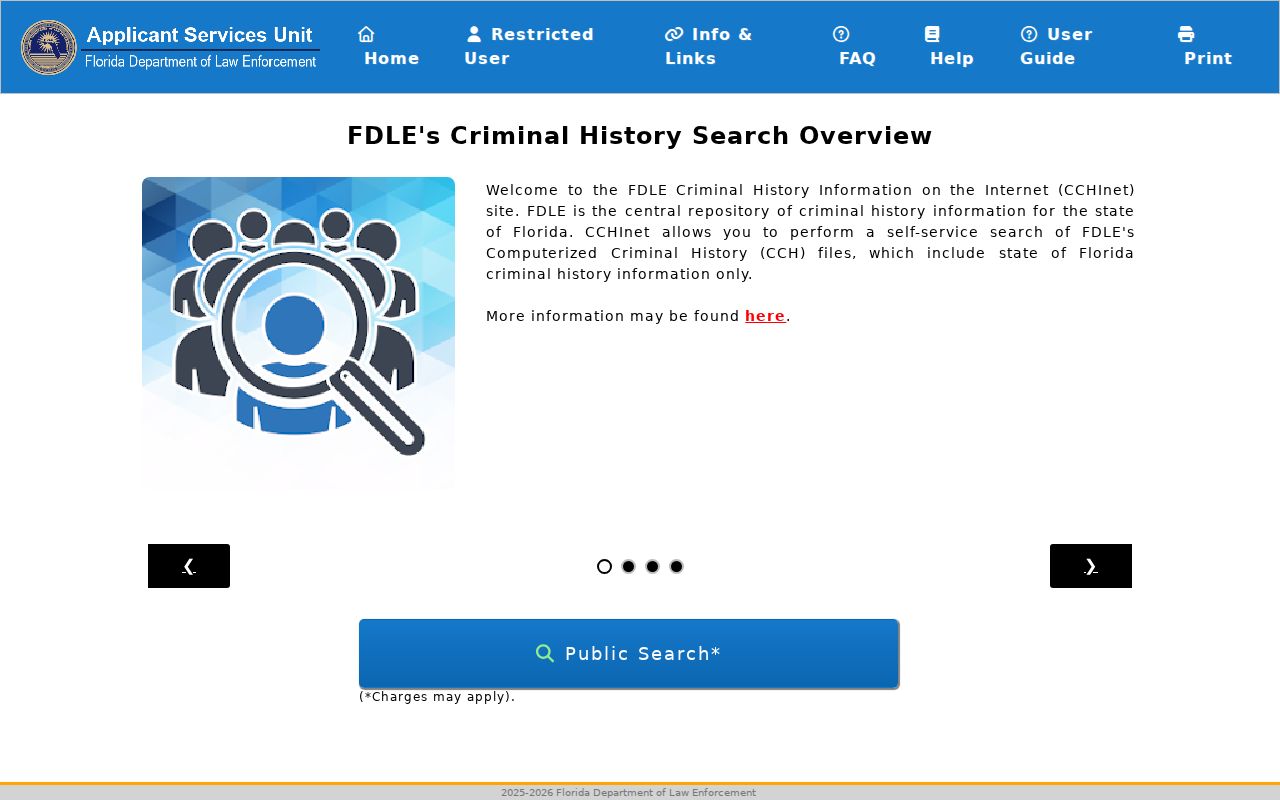
This screen is a state history channel, not a substitute for certified Seminole County court documents or fingerprint identification.
Read Seminole Court Records Carefully
A Seminole County Clerk result can expose the case number, court type, filing date, parties, filed counts, judge or division, hearings, docket events, disposition, sentence, and financial entries. Document images may be absent, redacted, or available only through the Clerk. Older files and certified copies may require a call to the Criminal Division at 407-665-4300.
| Search control | Best use | Important limit |
|---|---|---|
| Last and first name | Find possible person matches | Spelling and common names can mislead |
| Case number | Open a known case | Keep the format shown by the Clerk |
| Citation number | Locate criminal traffic matters | Not every arrest begins with a citation |
| Case type and date | Narrow a broad list | Filters may change with the vendor |
The Clerk's criminal payment page also documents the official payment routes.
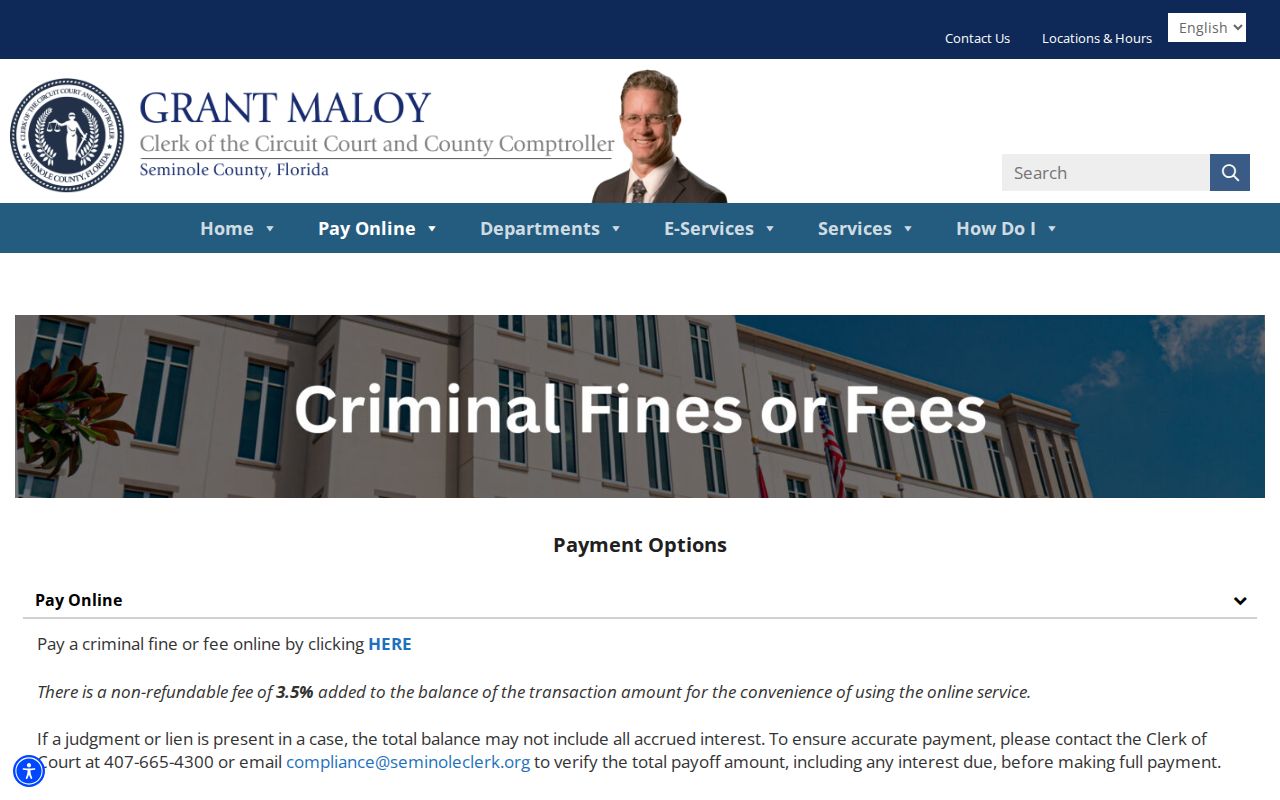
Online payments add 3.5 percent, automated phone payments add 4 percent, and representative-assisted phone payments add 6 percent; a displayed payoff may omit accrued judgment interest.
Kinds of Criminal Records
One Seminole County event can create several records. Each reflects a different stage and custodian. The police narrative describes what officers reported. The booking file records intake and custody. The State Attorney decides what to file, and the Clerk records what the court does. FDLE links the arrest and reported disposition cycle at the state level.
- Incident or arrest report: the creating sheriff or police department keeps the narrative and evidence references.
- Booking record: John E. Polk records intake time, charges, bond, and release or custody status.
- Court case: the Clerk keeps filed counts, hearings, orders, disposition, sentence, and financial entries.
- State history: FDLE compiles reported Florida arrest and disposition cycles, subject to reporting lag.
- Warrant or supervision record: the court docket and responsible law-enforcement or corrections agency may hold different parts.
The Seminole County Sheriff's Office homepage is the official starting point for its reports, custody tools, and services.

It does not replace city police report channels or the Clerk's filed court record.
Seven Police Custodians, One Jail
Sanford, Altamonte Springs, Oviedo, Casselberry, Winter Springs, Longwood, and Lake Mary each have police departments that keep their own city-generated reports. SCSO holds its own incident files and books county detainees at John E. Polk. Florida Highway Patrol or a campus agency may control a report when it handled the event. Identify the arresting or investigating agency before sending a request.
The SCSO Public Records Unit accepts requests for SCSO incident and crash reports, calls for service, local record checks, statistics, and related SCSO products.
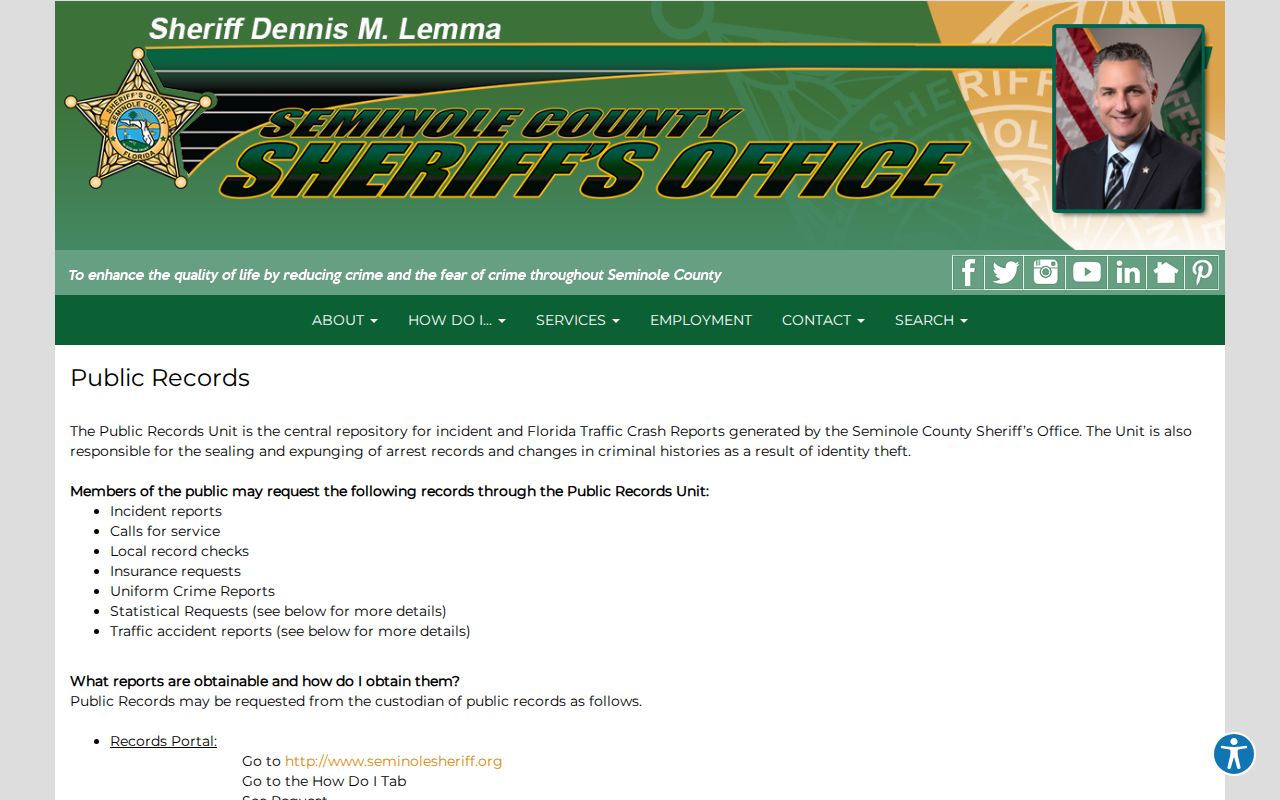
A precise request should give the incident number, date range, location, and exact record or media sought. Broad searches or video review can lead to a lawful special-service charge.
Note: Florida generally permits an anonymous public-record request, although contact details can help the custodian clarify, estimate, and deliver it.
Seminole County Criminal Records: What They Contain
The phrase criminal record can mean a rap sheet, a case file, or a booking entry. Those products should not be merged. An FDLE history organizes identifiers and reported arrest cycles. The court file centers on filed counts and judicial action. A current booking page centers on present custody and intake information.
Match each field to its source before drawing a conclusion. Booking charges show intake allegations, while the Clerk's disposition states how the filed count ended and FDC reports qualifying state custody or supervision.
| Name and identifiers | Reported name, aliases, date-of-birth data, or agency identifiers, with public details varying by source. |
|---|---|
| Arrest and booking | Arrest date and agency, booking number, intake charges, custody status, bond, and release data. |
| Charges and statutes | Alleged arrest charges or later filed counts, which may not match each other. |
| Disposition | The outcome for each filed count, such as dismissal, plea, acquittal, or adjudication. |
| Sentence | Custody, probation, fines, costs, restitution, or other court orders when public. |
| Supervision status | Qualifying FDC incarceration or community-supervision details, separate from the county jail roster. |
- Disposition
- The result of a case or count.
- Nolle prosequi
- The prosecutor's formal decision not to proceed on a charge.
- Adjudication withheld
- A court withholds a formal conviction after a plea or finding when Florida law allows.
- Capias
- A court command directing that a person be taken into custody.
Seminole Inmate Results Show Custody
The John E. Polk current-inmate roster is an operational snapshot. It may show a booking identifier, booking date, current charges, bond or purge information, and custody status. A missing name does not prove that no arrest occurred. The person may have bonded out, been released, transferred, or never entered Seminole County custody. The sheriff's current-inmate search is the official county source for a recent booking or present detention.
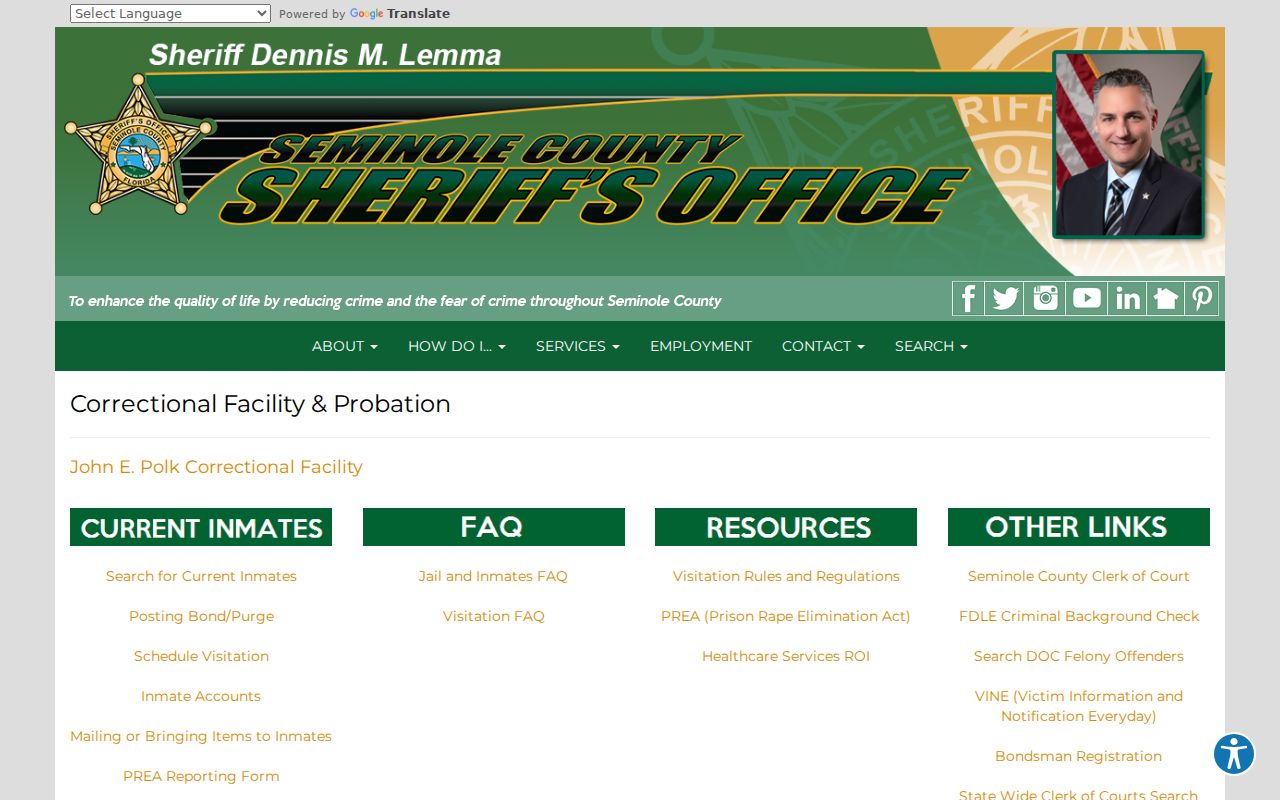
After locating a booking, compare its intake charges with the later Clerk docket because State Attorney review can change or decline them.
Regular personal mail is also tied to the booking number. The official MailGuard instructions route it through Pinellas Park for scanning rather than direct delivery to Sanford.
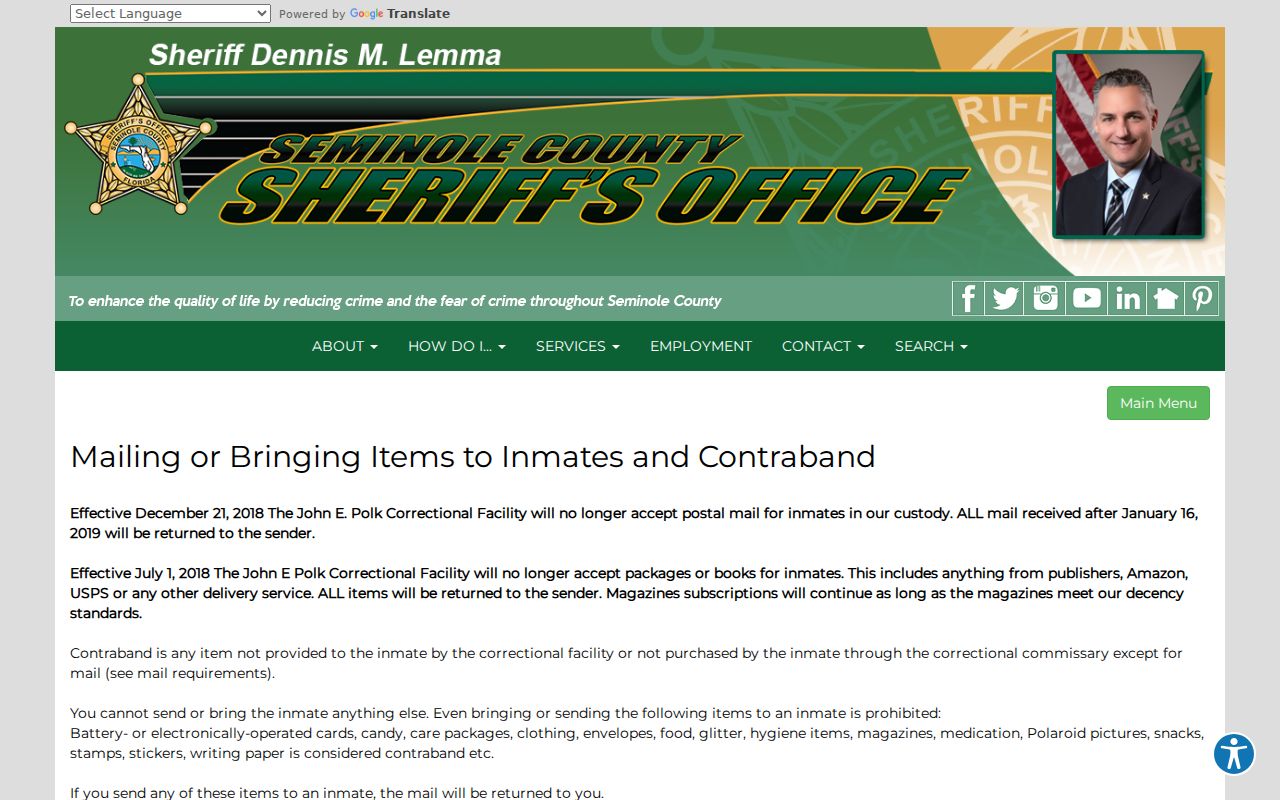
That unusual mail path underscores why a booking number is useful even though jail correspondence is not a court disposition.
Florida Public Access Laws
Florida starts with broad access, but it does not make every criminal record public. A custodian releases nonexempt material within a reasonable time and may charge for copies or unusually extensive work. Active-investigation details, protected victim data, juvenile material, security information, sealed cases, and specified identifiers can be withheld or redacted. Court clerks also apply statewide court-record confidentiality rules.
Key Florida authorities:
Florida Constitution, article I, section 24 establishes access to government records subject to exemptions.
Florida Statutes, chapter 119 sets the inspection, copying, and public-record request framework.
Florida Statutes, section 943.053 governs public dissemination of criminal-history information.
Florida court rule 2.420 governs access and confidentiality in court records.
Note: A requester usually need not cite chapter 119 or explain a purpose, but a narrow description helps the right office find the record.
Seminole Warrant Records Need Verification
FDLE's Wanted Persons Search and a Seminole County Clerk docket can reveal some warrant or capias data, yet a negative result is not legal clearance. Reporting can lag. Sealed process will not appear, and not every court event is represented in one public tool. Check the issuing case with the Clerk and contact SCSO for official execution or surrender instructions.
An arrest warrant rests on probable cause. A bench warrant or capias often follows a missed appearance or court noncompliance. A violation-of-probation warrant arises from supervision allegations, while a search warrant may remain sealed during an investigation. Only the issuing court can recall or quash its process. Paying an unrelated court balance does not necessarily clear it.
Safety: Do not try to detain or confront anyone named in wanted-person data. If your own warrant may be active, seek legal advice and confirm instructions with the issuing court or agency.
Seminole Records After State Transfer
John E. Polk covers county detention, including pretrial custody and some people awaiting transfer. Once a state sentence enters the Florida Department of Corrections system, the correct lookup changes. FDC Offender Search covers state prison and qualifying community-supervision records. The Clerk docket remains the source for the judgment and sentence that led there.
The official FDC Offender Search is the state-level locator after transfer or for a qualifying supervision status.
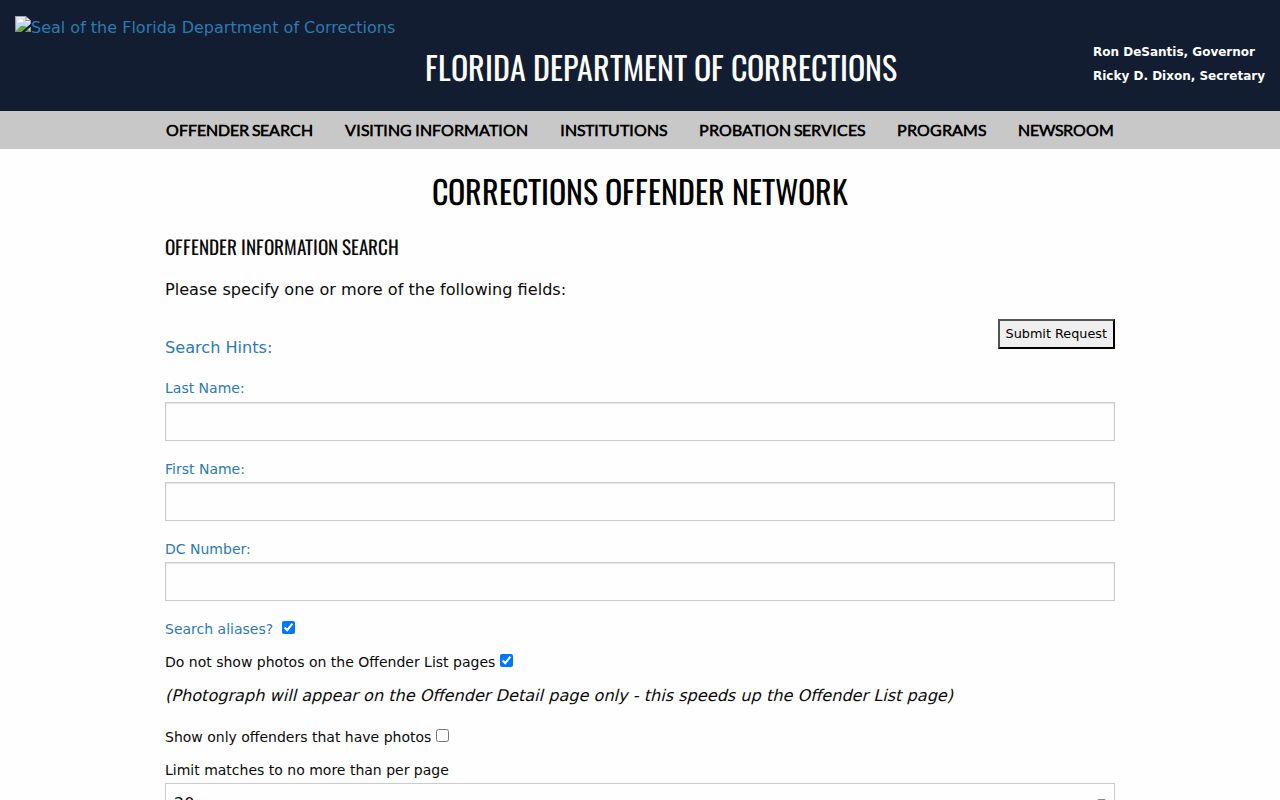
A result there does not replace the Seminole County case file, and a county inmate roster should not be used to infer state-prison history.
Restricted, Sealed & Expunged Records
A dismissal does not automatically remove a Seminole County arrest from public systems. Florida usually requires an eligible person to obtain an FDLE Certificate of Eligibility and then petition the court that handled the case. The certificate is not itself a court order and does not guarantee relief. Prior convictions, prior relief, certain pleas, and listed ineligible offenses may bar the remedy.
The practical route begins with a certified disposition from the Seminole Clerk. The applicant then follows FDLE's current certificate packet, including fingerprints and the $75 state processing fee unless the form provides an exception. After the certificate issues, the petition, affidavit, certificate, and proposed order go into the original case. The Clerk's separate sealing and expungement service charge documented by the research is $42, apart from other filing costs that should be confirmed.
Sealing blocks ordinary public access while preserving access for entities named by law. Expungement directs destruction as the statute provides, while FDLE retains a limited confidential entry. After an order, allow agencies time to process it and use Personal Review plus the Clerk search to check the result.
Seminole and FDLE Records Differ
A local SCSO check, a Clerk search, and an FDLE history answer different questions. The local check reflects the sheriff's own data. The Clerk shows filed Seminole County cases. CCHInet reaches reported public Florida history, but its name match is not fingerprint-positive and repository reporting can lag. For a gap in your own record, use FDLE Personal Review and send the challenge to the repository rather than asking a court-search vendor to rewrite state data.
FDLE's Sexual Offenders and Predators Search is another distinct statutory database.
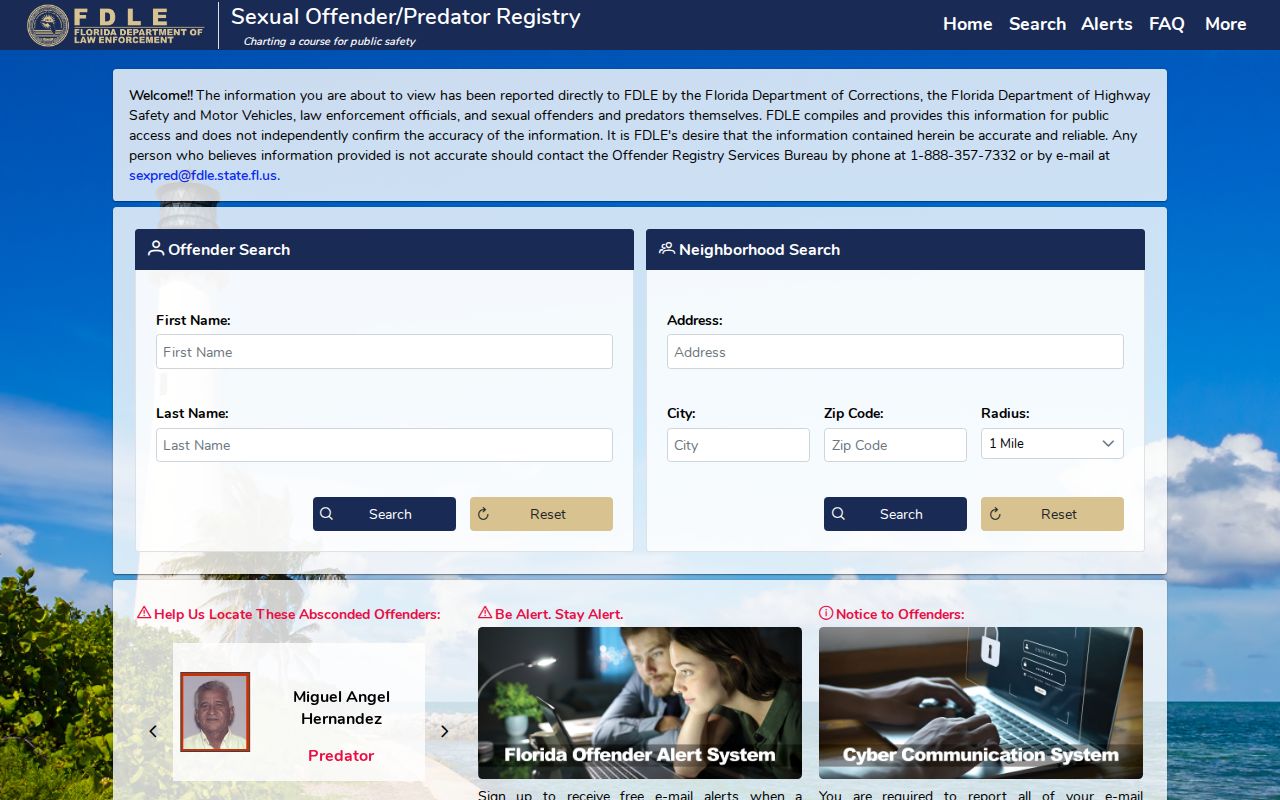
A registry listing is not a complete criminal history. For lawful neighborhood awareness and profile details, use the dedicated Seminole County sex offender lookup and verify current data with FDLE.
City-by-City Criminal Records in Seminole County
Seminole County's three largest incorporated cities are Sanford, Altamonte Springs, and Oviedo based on July 2025 Census estimates. Each police department keeps its own incident and arrest narratives. Bookable arrests ordinarily move into the county jail system, and filed cases move to the Seminole Clerk. None of these cities operates a separate public municipal criminal-court database.
Sanford Record Check
Population estimate 67,483. Sanford PD keeps city reports, while Five Points holds county booking and court records.
Altamonte Springs Record Check
Population estimate 48,000. ASPD is the report custodian for city events, including those near the I-4 corridor.
Oviedo Record Check
Population estimate 41,317. Confirm whether OPD, SCSO, FHP, or campus police handled an Oviedo-area event.
Start with the city department for its report, then use SCSO for the county booking and the Clerk for filed charges and the final court result.
Seminole Criminal History Reporting Gaps
Records do not appear everywhere at once. A booking may post before the Clerk opens a case. The State Attorney may later file different counts or decline prosecution. Court disposition reporting can take time to reach FDLE. Release removes a person from a current-inmate list, while the historical arrest and court file may remain.
Resolve a mismatch by tracing the source. Ask the arresting agency about its narrative, SCSO about the booking, the Clerk about filed counts and disposition, and FDLE about the statewide cycle. The Florida Statistical Analysis Center also warns that its data depend on reporting entities and update schedules. Label any crime figure by agency, year, and system rather than mixing calls for service, arrests, and reported offenses.
That source-by-source method is slower than relying on one name result, but it preserves the most important distinctions: allegation is not conviction, current custody is not criminal history, and a dismissed case is not automatically sealed.