
Sanford Criminal History Checks
Identify the product before searching. A Sanford police report explains the officer response; a John E. Polk booking documents intake and custody; a Seminole Clerk docket shows filed charges and disposition; and an FDLE result organizes reported Florida arrest cycles. None substitutes for all the others.
Use the event's agency name, case number, booking number, or court number to keep the search tied to the correct person and incident. Similar names alone do not establish identity, and a recent arrest may reach each system at a different time.
- Confirm Sanford Police Department made the report from the agency or booking information.
- Request the incident, arrest, crash, CAD, evidence, or other precisely identified record from SPD.
- Search the Seminole Clerk because Sanford has no separate municipal criminal-case portal.
- Use the SCSO current-inmate search for present custody and John E. Polk booking details.
- Use FDLE CCHInet for a paid name search or Personal Review for fingerprint-based review of your own record.
Requesting a Sanford Police Report
The SPD Records Unit accepts requests online, by email, by mail marked “Attn: Records Unit,” and at its counter. Give the case or incident number when possible. If it is unknown, narrow the search with event date and time, address, involved name, subject, date range, and exact media requested. A body-worn-camera request should identify the encounter rather than ask broadly for all video.
The form may collect a description, department, incident number, location, delivery format, and attachments. Contact details help with estimates and clarification, although Florida law generally permits requests without stating a purpose. Reports are normally submitted by shift end but require supervisor approval.
The official Sanford Police Records page identifies the city channel used for requests.
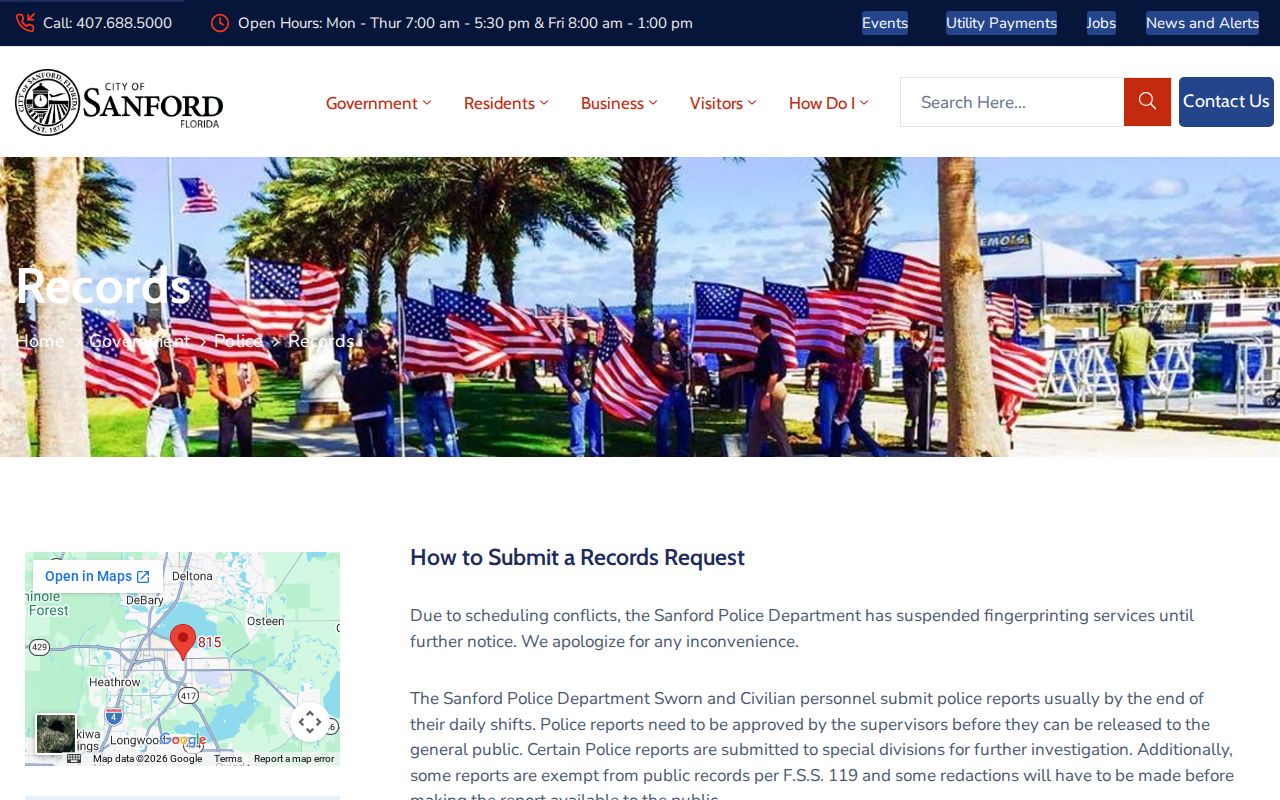
The page is a route to the records process, not the report itself. Confirm current form links, closures, and delivery instructions before submitting identifiers.
Records at the Sanford Police Department
SPD creates incident, arrest, crash, CAD, and evidence records within its jurisdiction. Its Records Unit is in the Public Safety Building at 815 Historic Goldsboro Boulevard, Sanford, FL 32771. Call 407-688-5070. Published hours are Monday through Friday, 8 a.m. to 5 p.m.
Paper copies are 15 cents one-sided and 20 cents double-sided. Oversized copies, audio, and CDs may be charged at actual cost. Sanford lists $25 per hour for extensive service after the first 15 minutes. Redaction review, active investigations, exempt victim information, and large video requests can add time or cost. SPD fingerprinting is suspended until further notice.
City Clerk or Police Records Unit
Sanford has a broader city public-record process, but the police Records Unit is the direct custodian for an SPD incident or arrest narrative. Non-police administrative records belong with the City Clerk. Sending a police request to SCSO merely because the jail later handled booking can delay the search.
Record split: Ask SPD for the officer narrative, SCSO for booking, and the Seminole Clerk for the filed case and disposition.
An eligible nonemergency event may be reported online only when it occurred in SPD jurisdiction and there is no known suspect. Completion creates a confirmation, assigns a case number, and provides a printable copy. That reporting function does not replace a request for an existing file.
Booking and Arrest Records in Sanford
For a bookable SPD arrest, the city report remains with Sanford while intake ordinarily occurs at John E. Polk Correctional Facility, 211 Eslinger Way. The SCSO current-inmate result can show booking number, intake charges, bond, and custody. It is a current snapshot, not a complete Sanford arrest archive.
Someone who bonded out, was released, transferred, or never entered the facility may be absent. Continue with the SPD report and Clerk search. Intake charges can differ from charges later filed after State Attorney review, so check the disposition before describing an outcome.
Sanford's Five Points Records Campus
Sanford is both a city with its own police department and the county seat. The courthouse, SCSO headquarters, and jail cluster at Five Points, separate from historic downtown. The Criminal Justice Courthouse is listed at 101 Eslinger Way, SCSO at 100 Eslinger Way, and John E. Polk at 211 Eslinger Way.
Proximity does not merge custody. A court copy comes from the Clerk, a booking question goes to SCSO, and an SPD narrative stays with city police. County material sometimes renders the courthouse road as Bush Boulevard and sometimes Eslinger Way, so confirm the destination before visiting.
The Sanford Municipal Court File
Sanford does not maintain a separate municipal criminal docket. Florida's unified court structure places misdemeanors, criminal traffic, and ordinance-related prosecutions in County Court, while Circuit Court handles felonies. Search Seminole Clerk Court Records or call 407-665-4300.
Search by person or case number, narrow by case type and date when available, and open the correct docket to compare every filed count with its disposition. Request an older, unimaged, plain, or certified document from the Clerk rather than from Sanford City Hall.
| Court Name | Seminole County and Circuit Courts, Eighteenth Judicial Circuit |
|---|---|
| Case Types Heard | County Court handles misdemeanors, criminal traffic, and ordinance matters; Circuit Court handles felonies |
| Case Lookup Channel | Seminole Clerk Court Records online or Criminal Division at 407-665-4300 |
| What the Docket Shows | Case number, filed counts, events, hearings, disposition, sentence entries, and available documents |
| Copies & Fees | Request inspection, plain copies, or certified copies; exact copy fee was not established in the research |
Checking a Sanford Arrest After Release
Removal from the current-inmate roster means only that the person is not presently shown there. Save identifiers when available, search the Clerk by name or case number, and request the SPD narrative using event details. A filed case may appear after booking, and the prosecutor may change or decline initial allegations.
Read every count through disposition. Pending, dismissal, nolle prosequi, withheld adjudication, and conviction are different outcomes. Older or unimaged documents may require a call to the Clerk and an inspection or copy request.
How Sanford Records Reach the County
SPD documents the event and sends an arrestee into county booking. The State Attorney decides what to file, the Clerk maintains the resulting County or Circuit Court docket, and dispositions feed the statewide process.
Record flow: Sanford PD › Seminole County Courts › Florida Department of Law Enforcement
For recent activity, begin with the city report and current-inmate system. For a mature case, the Clerk provides the legal outcome. FDLE is the statewide layer, but reporting lag or incomplete dispositions may require comparison with the court file.
Florida Highway Patrol or Sanford PD
A Sanford address does not prove SPD handled the event. Florida Highway Patrol may investigate major-road incidents, SCSO handles its jurisdiction, and agencies can participate jointly. The arresting-agency field or agency name on the report number is the best routing clue.
Request the narrative from its creator. SCSO can provide county booking even when another department made the arrest, but it cannot replace that agency's investigative file. This distinction helps when a location-only SPD search finds nothing.
Sanford Report, Docket and FDLE History
These three sources are often confused because each can mention the same arrest. The SPD report is event-centered. It may include dispatch information, officer observations, statements, evidence references, and the allegations supporting enforcement. Release can be delayed by supervisor approval, an active investigation, victim protections, or media redaction. It does not establish the final court outcome.
The Seminole Clerk docket is case-centered. Search by person or known case number, narrow by criminal case type or date, and compare multiple identifiers before selecting a common name. The case view can show filed counts, the information or charging document, hearings, motions, plea events, orders, disposition, sentence, and financial entries. An arrest charge can be changed, added, or declined before filing, so the docket deserves its own reading.
The FDLE history is cycle-centered and statewide. CCHInet is a paid, name-based public search, currently researched at $24 plus the stated $1 online card fee. A name match does not provide fingerprint-positive identification. For examination and correction of one's own Florida repository record, the free FDLE Personal Review uses fingerprints taken by a criminal-justice or law-enforcement agency. It is not a certified product, but it is the appropriate self-review channel when an arrest cycle lacks a disposition.
Lake Monroe and Modern Jurisdiction
Sanford grew around Lake Monroe and was incorporated in 1877, while its role as county seat later placed major justice institutions at the Five Points campus. Historic downtown, the city Public Safety Building on Historic Goldsboro Boulevard, and the county campus on Eslinger Way are separate destinations. A requester should not assume that “downtown Sanford” describes where a modern police, jail, or criminal-court record is kept.
Likewise, old crime figures need a year label. FDLE's 2021 table reported a Sanford population of 62,045, 1,754 index crimes, a rate of 2,827 per 100,000, and a 19.6 percent clearance measure. Those are historical agency-year statistics, not current safety conditions, and the clearance percentage does not mean that percentage of arrested people were convicted. Record requests should focus on the actual event, while statistical comparisons should keep year, agency, population basis, and measure aligned.
Sanford Record Access Rules
Florida starts from broad access, not universal disclosure. Sanford releases nonexempt records within a reasonable time and may charge lawful duplication and extensive-service costs. Active-investigation material, confidential victim information, juvenile records, protected identifiers, and sensitive evidence may be withheld or redacted. Courts also apply judicial confidentiality rules.
A narrow request for a known report, date, location, and media type helps the custodian locate responsive material and estimate redaction work. A redacted or withheld portion should not be treated as proof that no underlying record exists.
Key Statutes: Florida Constitution article I, section 24 establishes access subject to exemptions; Florida Statutes chapter 119 provides the inspection, copying, fee, and exemption framework.
Florida Rule 2.420 governs access and confidentiality in court records.