
Altamonte Springs Criminal History Checks
Choose a source by record type. ASPD holds city police material, SCSO holds the county booking, the Seminole Clerk holds filed County and Circuit Court cases, and FDLE supplies the statewide history product. A complete answer may require comparing several records.
Begin with an event number, case number, date, location, or arresting-agency label whenever available. That information separates an ASPD event from an I-4 response handled by FHP or another agency and reduces mistaken matches between similar names.
- Confirm ASPD is the arresting or reporting agency, especially for an I-4 event.
- Request the adult arrest, closed incident, crash, or evidence record through ASPD Records.
- Search the Seminole Clerk because the city has no separate criminal docket.
- Check SCSO Current Inmates for present John E. Polk custody and booking information.
- Use FDLE CCHInet for statewide name-based results or Personal Review for your own fingerprint-based record.
Altamonte Police Records Counter
The ASPD Records Section is at 225 Newburyport Avenue, Altamonte Springs, FL 32701. Call 407-571-8214 or fax 407-571-8221. Published hours are Monday through Friday, 7:30 a.m. to 4:30 p.m. Requests may be made at the counter, by phone, by mail, or with the web form.
ASPD releases adult arrest reports, qualifying juvenile-felony arrest reports, and closed incident or offense reports when no exemption controls. Active criminal intelligence and active investigations remain restricted. Describe the exact record and ask whether inspection, electronic delivery, or paper copies fit the request.
The official Altamonte Springs Records page identifies the police counter and services.
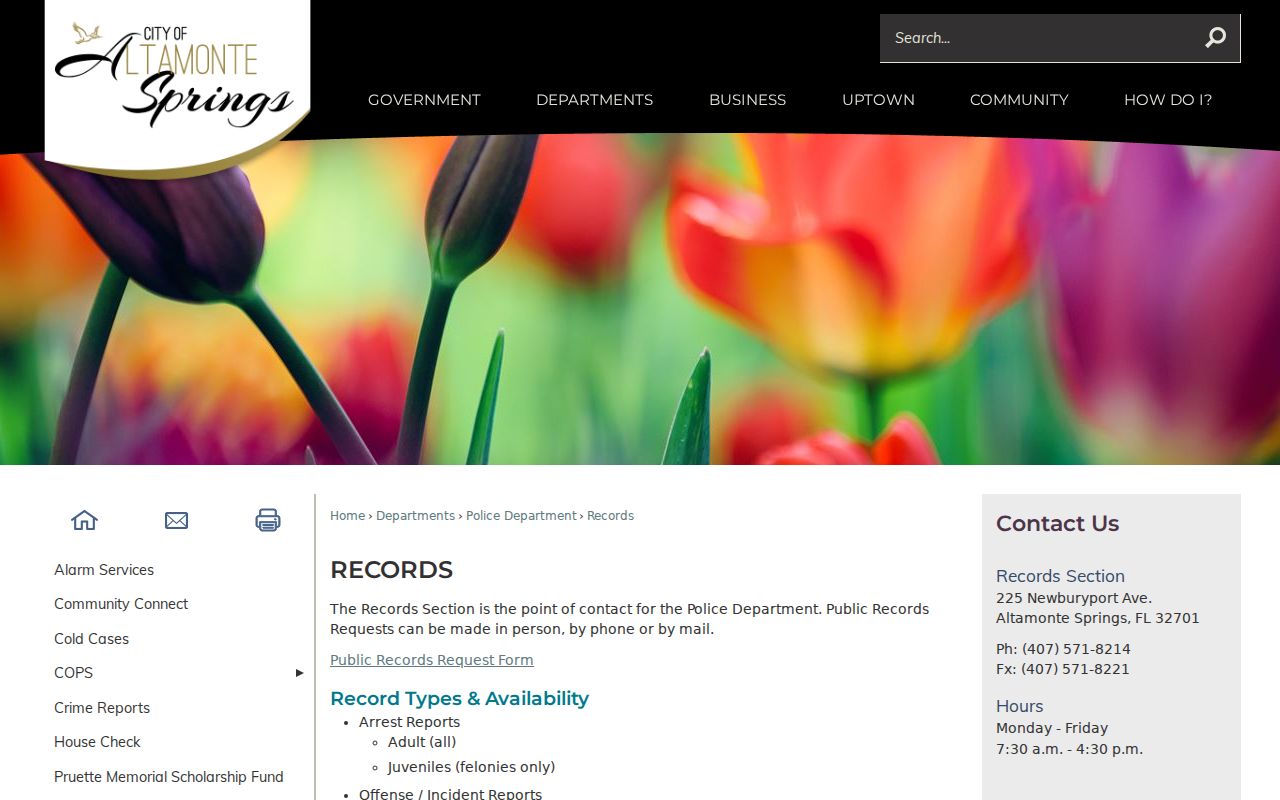
The city page is a current starting point, while the released document still depends on record status, requester qualification, redaction, and a sufficiently narrow description.
Records at the Altamonte Springs Police Department
ASPD is custodian of reports its officers create. A useful request provides case number, incident type, date and time, location, and a focused description. CityProtect can filter by date, time, and incident type, but the city warns that not every crime appears. It is an awareness tool, not a substitute for an official report or court disposition.
Copy charges are 15 cents for a single-sided page and 20 cents for duplex. A DVD is $1.15. Published service fees include $4 for repair verification, $10 for VIN verification, and $5 per notary stamp. Fingerprinting is offered at the Altamonte Mall COPS substation, so verify availability before travel.
Using the Altamonte Request Form
The form asks the requester to choose inspection or copies and describe the desired record. Fields include case number, incident type, date and time, period, requester contact information, an acknowledgment tied to section 119.105, optional email delivery, and submission controls. Florida law permits anonymous public-record requests, but without contact information the custodian may be unable to deliver an estimate or ask a narrowing question.
The official ASPD Public Records Request Form presents those choices.
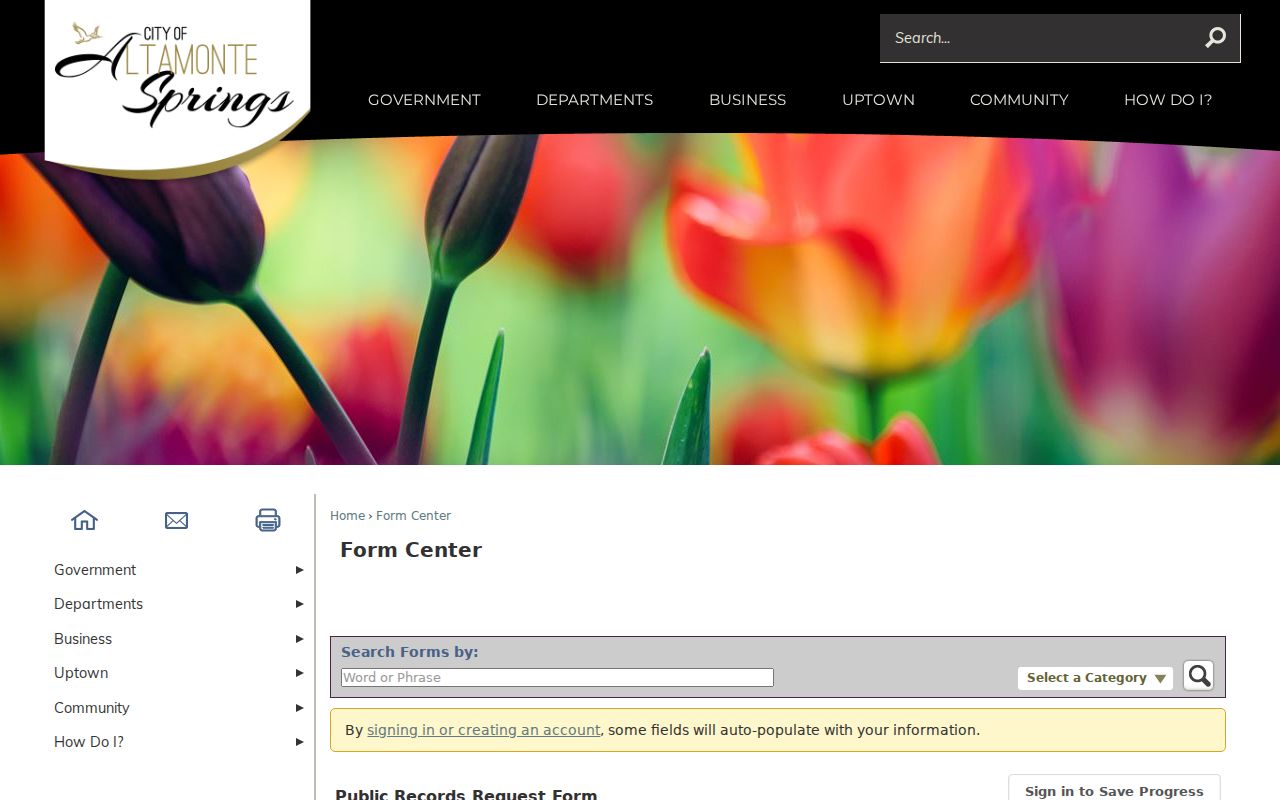
Use only necessary personal information. A precise event number, date, location, and record category usually helps more than a broad narrative about why the record is wanted.
Booking and Arrest Records in Altamonte Springs
A bookable ASPD arrest ordinarily leads to John E. Polk Correctional Facility in Sanford. The county roster can show current custody, intake charges, bond, booking date, and identifiers. ASPD still owns its narrative, evidence, and city arrest report. Requesting only the booking omits what officers documented.
A missing current-inmate result does not prove there was no arrest. The person may have bonded, been released, transferred, or never entered county custody. Search the Clerk next and request the ASPD record. Charges at intake can change after prosecutor review.
Identifying the I-4 Arresting Agency
Altamonte Springs is a commercial and residential center along the I-4 corridor. Roadway events can involve ASPD, SCSO, Florida Highway Patrol, or more than one agency. Use the booking's arresting-agency field, the report prefix, or the responding agency shown on paperwork before choosing a records counter.
SCSO may hold the John E. Polk booking even when it did not investigate the incident. Conversely, ASPD may hold a report while the later prosecution and judgment belong to county offices. Location alone is not a reliable custodian test.
The Altamonte Springs Municipal Court File
There is no separate Altamonte Springs municipal criminal docket portal. County Court handles misdemeanors, criminal traffic, and applicable ordinance prosecutions, while Circuit Court handles felony cases. Search the Seminole Clerk's official court-record system and call 407-665-4300 for unavailable images or certified copies.
The docket should be read count by count because the arrest allegations may differ from the charges the State Attorney files. Use the case number for copy requests and ask the Clerk, not the ASPD counter, to authenticate a court disposition.
| Court Name | Seminole County and Circuit Courts, Eighteenth Judicial Circuit |
|---|---|
| Case Types Heard | County misdemeanors, criminal traffic and ordinance matters; Circuit felonies |
| Case Lookup Channel | Seminole Clerk Court Records or Criminal Division, 407-665-4300 |
| What the Docket Shows | Filed counts, case events, hearings, disposition, sentence entries, and available documents |
| Copies & Fees | Inspection, plain or certified copies through the Clerk; exact copy fee was not established in research |
From Police Narrative to Disposition
The ASPD narrative records the reported event and investigative observations. The booking entry records custody. The State Attorney decides what charges to file, and the Clerk docket records court events and outcomes. An arrest allegation is not a conviction and should not be summarized as one.
Compare each filed count with its disposition. A dismissal, nolle prosequi, acquittal, withheld adjudication, pending matter, and conviction carry different meanings. FDLE reporting may lag, so a court disposition is the useful comparison when a statewide cycle looks incomplete.
How Altamonte Springs Records Reach the County
ASPD creates the city report, county detention creates the booking, and the prosecutor and courts create the filed case and final disposition. Fingerprint and disposition reporting then contributes to FDLE's statewide criminal-history system.
Record flow: Altamonte Springs PD › Seminole County Courts › Florida Department of Law Enforcement
Search recent custody through SCSO, city facts through ASPD, and legal outcomes through the Clerk. Use FDLE when statewide context is needed, while recognizing a name search does not establish fingerprint-positive identity.
Altamonte Crash Report Timing
ASPD advises allowing three to five business days for a crash report. Florida also restricts access to crash reports for 60 days to qualified requesters. A person seeking one during that window should be prepared to establish eligibility rather than treating it like an ordinary closed incident report.
A crash report and an incident or arrest report are different products. Identify which one is needed, since related enforcement can produce more than one file and each can have different confidentiality and release rules.
When the Current Inmate Search Is Empty
The SCSO current-inmate roster covers present custody rather than every past Altamonte Springs arrest. A person may have posted bond, been released on recognizance, completed a short stay, transferred to another authority, or never been booked at John E. Polk. Spelling differences and a delay between arrest and intake can also affect a very recent search.
Continue methodically. Search the Seminole Clerk by name and date range for a filed case. Ask ASPD Records for the adult arrest report or closed incident report with the case number, event time, and location. If a state prison sentence later appears, move from the county roster to FDC Offender Search. Each transition reflects a different custody system, not disappearance of the underlying records.
When the Clerk result appears, compare intake charges with filed counts and the final disposition. Prosecutor review can change or decline initial allegations. Bond indicates pretrial release conditions, not guilt, and absence from custody does not resolve the case. These distinctions are important when reconstructing an event after release.
Reading Altamonte Crime Counts
Official FDLE 2021 figures listed Altamonte Springs with a population of 46,735, 892 index crimes, a rate of 1,908.6 per 100,000, and 30.4 percent clearance. Those values must remain attached to 2021 and their reporting program. They should not be described as present conditions or combined with newer population estimates without recalculation from compatible data.
Calls for service, reported offenses, arrests, and clearances are separate measures. One call can produce no crime report, several reports can concern related conduct, and a clearance is not the same as a conviction. CityProtect also warns that not all incidents appear. A person investigating a specific matter should request its official ASPD record and Clerk outcome rather than infer facts from a map point or annual total.
Altamonte Springs' dense commercial setting and I-4 position also make agency and denominator choices consequential. A roadway response by FHP should not be silently attributed to ASPD, and a city statistic should not be compared directly with a countywide number. State the agency, reporting year, geographic boundary, and measure every time a figure is used.
The 2025 Census estimate of 48,000 identifies the city's present population context but does not update the older offense numerator. Combining it with 2021 offenses would create an unsupported rate. Keep each published data series intact, and use the public-record process for the underlying city material when a precise historical comparison is genuinely needed.
Altamonte Springs Record Access Rules
Florida requires access to nonexempt public records within a reasonable time, but active investigations, protected victims, confidential juvenile material, intelligence, sealed cases, and protected identifiers may be withheld or redacted. Lawful copy charges and an extensive-use service charge can apply. Judicial records also follow court confidentiality rules.
Requesting a defined incident, date range, format, and media type lets ASPD assess responsive records and redaction more accurately. Anonymous requests remain permitted, although a delivery address or contact method may be necessary to receive an estimate or released copy.
Key Statutes: Florida Constitution article I, section 24 establishes access subject to exemptions; Florida Statutes chapter 119 governs local inspection, copies, fees, and exemptions.
Florida Rule 2.420 governs court-record access and confidentiality.